 ORIGINAL: Cartier Cuts 7.9 g/t Au Over 4.0 m Within A Broader Segment of 2.3 g/t Au Over 19.0 m at Hope Sector (Cadillac); Unlocks New High-Grade Gold Zone in Underexplored Pontiac Sediments
2026-04-23 08:00 ET – News Release
VAL-D’OR, Quebec, April 23, 2026 (GLOBE NEWSWIRE) — Cartier Resources Inc. (″ Cartier ″ or the ″ Company ″) (TSXV: ECR; FSE: 6CA) is pleased to announce the eleventh batch of results from the 100,000-m drilling program (2 drill rigs), within the underexplored Pontiac sedimentary Group in Hope Sector, on the 100%-owned Cadillac Project, located in Val-d’Or (Abitibi, Quebec).
Strategic Highlights from Hope Sector
Drill Hole Results (Figures 1 to 3)
New Zones
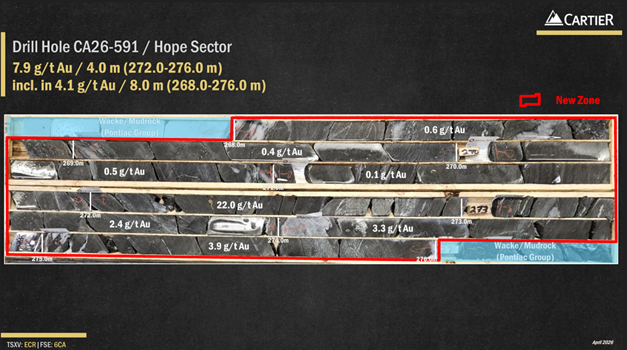
- CA26-591 reported 7.9 g/t Au over 4.0 m included in 2.3 g/t Au over 19.0 m, with visible gold grains.
- CA26-334 graded 7.8 g/t Au over 1.0 m included in 2.3 g/t Au over 4.0 m.
- CA26-335 intersected 3.1 g/t Au over 3.0 m included in 1.1 g/t Au over 11.0 m.
Porphyry #1 Zone
- CA26-334 reported 6.2 g/t Au over 1.0 m included in 2.7 g/t Au over 3.0 m.
Significance for Investors
- Hole CA26-591 introduces a new high-grade gold zone near surfacein the unexplored Pontiac sediments. The intersection is located south of the Cadillac Fault and 50 m south of the Porphyry #2 intrusion, which opens an entirely new exploration target.
- This new discovery closely resembles the gold mineralization in the Cadillac sediments, consisting of a stockwork of quartz-carbonate veins and veinlets accompanied by sulfides and visible gold grains. To date, only two holes have tested this discovery, demonstrating the mineralized zone is open in all directions and at depth, and signaling significant exploration potential.
- Drill holes CA26-334 and 335 intersected the Porphyry #1 intrusion, extending its westward dimension to at least 1 km in length, remains open at depth and suggests a sizeable intrusive system in play.
- The two mineralization styles (sediment-hosted gold and porphyry-related gold systems) elevate the Hope Sector as a highly strategic area for the Cadillac project, despite its early-stage exploration status, highlighting its strong potential for new gold discoveries.
Next Steps
- Further expansion drilling is being planned at the Hope Sector to unlock the full potential of these two new styles of mineralization (sediments and porphyries).
- Additional exploration drilling is already planned to testtwo new high-priority geophysical targets, namely:
- A 1,500 m strong chargeability anomaly, between the existing porphyry zones to test the expansion potential of the mineralized system or a new porphyry center;
- A 750 m ovoid magnetic anomaly, consistent with a sizable intrusive body often associated with porphyry mineralization.
” This second set of results underscores the emerging significance of the Hope sector, which remains at an early stage of development with considerable exploration runway ahead. The confirmation of a porphyry intrusion-related gold system (Porphyries #1 and #2) and a sediment-hosted gold mineralization, materially enhances the geological prospectivity of the Cadillac project. These discoveries point to the presence of multiple mineralizing systems, increasing the potential for scale and supporting a more diversified exploration model. With a footprint of approximately 30 km², the Hope Sector represents a meaningful growth opportunity, offering strong upside leverage through continued exploration, potential resource delineation, and long-term value creation. ” – Philippe Cloutier, President and CEO of Cartier.
” The underexplored Pontiac region represents a compelling opportunity for discovery, with strong indications of multiple gold-bearing lithologies, including porphyritic intrusions and sedimentary units. Over the coming months, an expanded drilling program will systematically evaluate the Pontiac land package, targeting new zones of gold mineralization and testing high-priority anomalies. This program is designed to unlock additional resource potential, drive new discoveries, and meaningfully enhance the overall value of the project. ” – Ronan Deroff, Vice President Exploration of Cartier.
Table 1: Drill hole best assay results from Hope Sector
| Hole Number | From (m) | To (m) | Core Length** (m) | Au (g/t) Uncut | Vertical Depth (m) | Zone |
| CA26-334 | 173.0 | 177.0 | 4.0 | 2.3 | ≈160 | – |
| Including | 173.0 | 174.0 | 1.0 | 7.8 | ||
| And | 313.0 | 316.0 | 3.0 | 2.7 | ≈280 | Porphyry #1 |
| Including | 314.0 | 315.0 | 1.0 | 6.2 | ||
| CA26-335 | 157.0 | 168.0 | 11.0 | 1.1 | ≈150 | – |
| Including | 157.0 | 160.0 | 3.0 | 3.1 | ||
| CA26-591 | 257.0 | 276.0 | 19.0 | 2.3* | ≈190 | – |
| Including | 272.0 | 276.0 | 4.0 | 7.9 |
* Occurrences of visible gold (VG) have been noted in the drill core at various intervals. ** Based on the observed intercept angles within the drill core, true thicknesses are estimated to represent approximately 60-90% of the reported core length intervals.
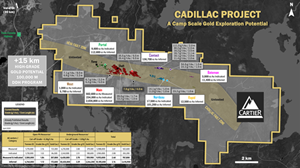
Figure 1: Location of the new drill results (regional plan view)
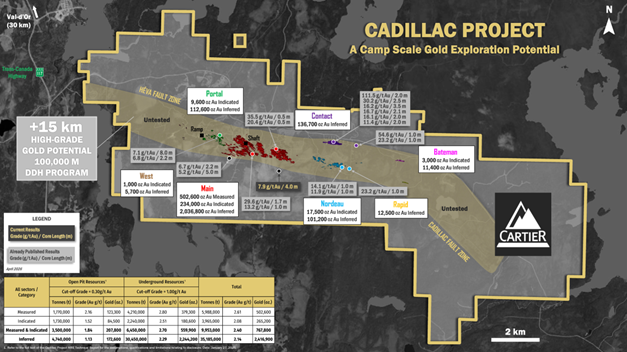
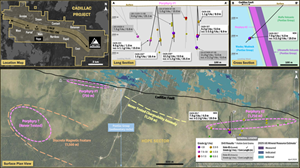
Figure 2: Plan view, cross and long sections of the Hope Sector
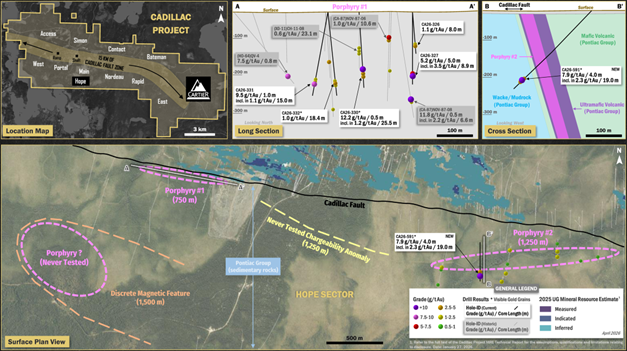
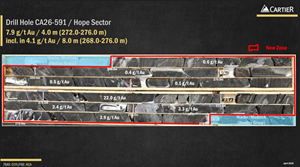
Figure 3: Photos of the drill core from hole CA26-591
Hope Sector
The Hope Sector is a newly identified highly prospective area and untested conceptual exploration opportunity, situated immediately south of the prolific Cadillac Fault, with potential to host a new style of gold mineralization (intrusion-related gold deposits) within the underexplored Pontiac sedimentary Group, supporting significant discovery upside. The known presence of the porphyritic felsic intrusion is a favorable horizon for hydrothermal fluid flow. This sector hosts several new high-priority drill targets identified through geoscientific compilation and modelling.
The Hope Sector, defined by at least two porphyry mineralized systems, are typically and primarily associated with a fine-grained and disseminated pyrite-pyrrhotite mineralization, with a pervasive silica-biotite-sericite-carbonate alteration, all crosscut by late-stage smoky and white quartz vein and veinlet stockworks containing visible gold. Locally, accessory minerals such as tourmaline are observed.
Milestones of 2025-2027 Exploration Program
100,000 m Drilling Program (Q3 2025 to Q2 2027)
The ambitious 600-hole drilling program will both expand known gold zones and test new shallow surface high-potential targets. The objective is to unlock the camp-scale, high-grade gold potential along the 15 km Cadillac Fault Zone. It is important to note that Cartier’s recent consolidation of this large land holding offers the unique opportunity in over 90 years for unrestricted exploration.
Environmental Baseline Studies & Economic Evaluation of Chimo mine tailings (Q3 2025 to Q3 2026)
The baseline studies will be divided into two distinct parts which include 1) environmental baseline desktop study and 2) preliminary environmental geochemical characterization. The initial baseline studies will provide a comprehensive understanding of the current environmental conditions and implement operations that minimize environmental impact while optimizing the economic potential of the project. These studies will be supplemented by an initial assessment of the economic potential of the past-producing Chimo mine tailings to determine whether a quantity of gold can be extracted economically.
Metallurgical Sampling and Testwork Program (Q4 2025 to Q1 2026)
The metallurgical testwork program includes defining of expected gold recovery rates and improving historical results from the Chimo deposit, as well as establishing metallurgical recovery data for the first-time for the East Chimo and West Nordeau satellite deposits, where no previous data exists. This comprehensive program will characterize the mineralized material, gold recovery potential and validate optimal grind size defining the most efficient and cost-effective flowsheet. The data generated will directly support optimized project development and have the potential to significantly reduce both capital and operating costs, while also improving the environmental footprint.
Table 2: Drill hole collar coordinates from Hope Sector
| Hole Number | UTM Easting (m) | UTM Northing (m) | Elevation (m) | Azimuth (°) | Dip (°) | Hole Length (m) |
| CA26-334 | 331052 | 5319918 | 340 | 225 | -64 | 336 |
| CA26-335 | 331052 | 5319918 | 340 | 180 | -72 | 348 |
| CA26-591 | 333593 | 5319172 | 347 | 190 | -44 | 300 |
Table 3: Drill hole detailed assay results from Hope Sector
| Hole Number | From (m) | To (m) | Core Length* (m) | Au (g/t) Uncut | Vertical Depth (m) | Zone |
| CA26-334 | 173.0 | 177.0 | 4.0 | 2.3 | ≈160 | – |
| Including | 173.0 | 174.0 | 1.0 | 7.8 | ||
| And | 195.0 | 197.0 | 2.0 | 2.6 | ≈175 | – |
| Including | 195.0 | 196.0 | 1.0 | 2.8 | ||
| Including | 196.0 | 197.0 | 1.0 | 2.4 | ||
| And | 212.0 | 213.0 | 1.0 | 1.6 | ≈190 | – |
| And | 224.1 | 225.1 | 1.0 | 1.0 | ≈200 | – |
| And | 313.0 | 316.0 | 3.0 | 2.7 | ≈280 | Porphyry #1 |
| Including | 313.0 | 314.0 | 1.0 | 1.2 | ||
| Including | 314.0 | 315.0 | 1.0 | 6.2 | ||
| CA26-335 | 157.0 | 168.0 | 11.0 | 1.1 | ≈150 | – |
| Including | 157.0 | 158.0 | 1.0 | 4.8 | ||
| Including | 159.0 | 160.0 | 1.0 | 4.0 | ||
| Including | 164.0 | 165.0 | 1.0 | 1.0 | ||
| And | 213.7 | 214.8 | 1.1 | 5.3 | ≈200 | – |
| CA26-591 | 147.5 | 148.5 | 1.0 | 2.9 | ≈110 | – |
| And | 163.0 | 164.0 | 1.0 | 1.1 | ≈120 | – |
| And | 257.0 | 276.0 | 19.0 | 2.3 | ≈190 | – |
| Including | 257.0 | 258.0 | 1.0 | 1.6 | ||
| Including | 258.0 | 259.0 | 1.0 | 4.8 | ||
| Including | 259.0 | 260.0 | 1.4 | 2.4* | ||
| Including | 272.0 | 273.0 | 1.0 | 22.0 | ||
| Including | 273.0 | 274.0 | 1.0 | 2.4 | ||
| Including | 274.0 | 275.0 | 1.0 | 3.3 | ||
| Including | 275.0 | 276.0 | 1.0 | 3.9 |
* Occurrences of visible gold (VG) have been noted in the drill core at various intervals. ** Based on the observed intercept angles within the drill core, true thicknesses are estimated to represent approximately 60-90% of the reported core length intervals.
Quality Assurance and Quality Control (QA/QC) Program
The drill core from the Cadillac Project is NQ-size and, upon receipt from the drill rig, is described and sampled by Cartier geologists. Core is sawn in half, with one half labelled, bagged and submitted for analysis and the other half retained and stored at Cartier’s coreshack facilities located in Val-d’Or, Quebec, for future reference and verification. As part of Quality Assurance and Quality Control (QA/QC) program, Cartier inserts blank samples and certified reference materials (standards) at regular intervals into the sample stream prior to shipment to monitor laboratory performance and analytical accuracy.
Drill core samples are sent to MSALABS’s analytical laboratory located in Val-d’Or, Quebec, for preparation and gold analysis. The entire sample is dried and crushed (70% passing a 2-millimeter sieve). The analysis for gold is performed on an approximately 500 g aliquot using Chrysos Photon Assay™ technology, which uses high-energy X-ray excitation with gamma detection to quickly and non-destructively measure gold content.
Alternatively, samples are submitted to Activation Laboratories Ltd. (“Actlabs”), located in either Val-d’Or or Ste-Germaine-Boulé, both in Quebec, for preparation and gold analysis. The entire sample is dried, crushed (90% passing a 2-millimetre sieve) and 250 g is pulverized (90% passing a 0.07-millimetre sieve). The analysis for gold is conducted using a 50 g fire assay fusion with atomic absorption spectroscopy (AAS) finish, with a detection limit up to 10,000 ppb. Samples exceeding this threshold are reanalyzed by fire assay with a gravimetric finish to determine high-grade values accurately.
Both MSALABS and Actlabs are ISO/IEC 17025 accredited for gold assays and implement industry-standard QA/QC protocols. Their internal quality control programs include the use of blanks, duplicates, and certified reference materials at set intervals, with established acceptance criteria to ensure data integrity and analytical precision.
Qualified Person
The scientific and technical content of this press release has been prepared, reviewed and approved by Mr. Ronan Déroff, P.Geo., M.Sc., Vice President Exploration, who is a ″ Qualified Person ″ as defined by National Instrument 43-101 – Standards of Disclosure for Mineral Projects (″ NI 43-101 ″).
About Cadillac Project
The Cadillac Project, covering 14,000 hectares along a 15-kilometre stretch of the Cadillac Fault, is one of the largest consolidated land packages in the Val-d’Or mining camp. Cartier’s flagship asset integrates the historic Chimo Mine and East Cadillac projects, creating a dominant position in a world class gold mining district. With excellent road access, year-round infrastructure and nearby milling capacity, the project is ideally positioned for rapid advancement and value creation.
The Cadillac property contains total gold resource of 767,800 ounces in the measured and indicated category (10.0 Mt at 2.4 g/t Au) and 2,416,900 ounces in the inferred category (35.2 Mt at 2.1 g/t Au) across all the sectors. Please see the ″ NI 43-101 Technical Report and Mineral Resource Estimate on the Cadillac Project, Val-d’Or, Abitibi, Quebec, Canada. Pierre-Luc Richard, P.Geo. of PLR Resources Inc., Stephen Coates, P.Eng. of Evomine Consulting Inc. and Florent Baril, P.Eng. of Bumigeme Inc. ″, effective January 27, 2026.
About Cartier Resources Inc.
Cartier Resources Inc., founded in 2006 and headquartered in Val-d’Or (Quebec) is a gold exploration company focused on building shareholder value through discovery and development in one of Canada’s most prolific mining camps. The Company combines strong technical expertise and a track record of successful exploration to advance its flagship Cadillac Project. Cartier’s strategy is clear: unlock the full potential of one of the largest undeveloped gold landholdings in Quebec.
For further information, contact:
Philippe Cloutier, P. Geo.
President and CEO
Telephone: 819-856-0512
[email protected]
www.ressourcescartier.com
Neither TSX Venture Exchange nor its Regulation Services Provider (as that term is defined in policies of the TSX Venture Exchange) accepts responsibility for the adequacy or accuracy of this release.
Photos accompanying this announcement are available at:
https://www.globenewswire.com/NewsRoom/AttachmentNg/b45e91a0-749e-44b0-a004-50431362c23d
https://www.globenewswire.com/NewsRoom/AttachmentNg/e8830a26-7611-46ae-90de-760fcdc5633a
https://www.globenewswire.com/NewsRoom/AttachmentNg/ff07966e-cada-487e-ac7e-b56247a461c1

Related Posts
Tags
Share This