Mayo Lake Minerals
Gold and Silver in the Heart of the Yukon
Mayo Lake Minerals Inc.
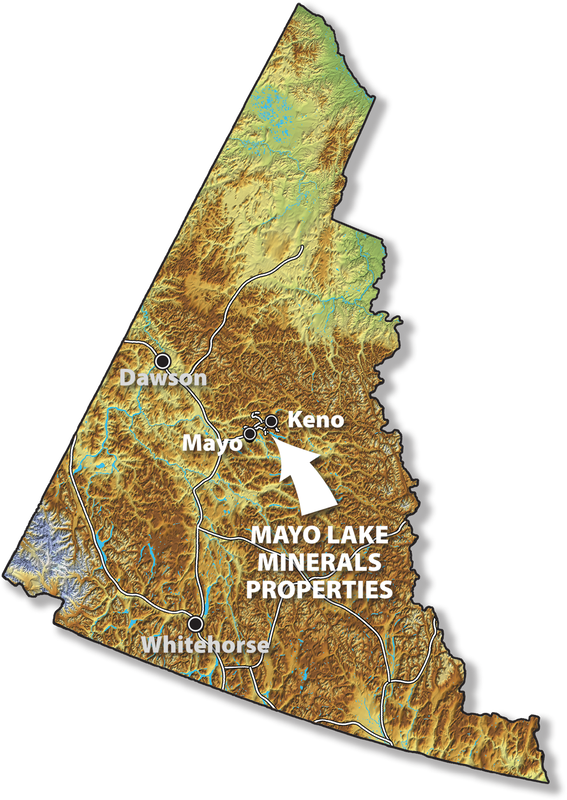
MAYO acquired its claim groups in 2011 because of:
- previously overlooked analytical results of stream sediment, and overlooked assays of heavy mineral samples for gold, which were reported by the Geological Survey of Canada in the Mayo Lake-Keno Hill area in the 1960s; and
- unexplored terrain in an area characterized by placer mining, around Mayo Lake,
- favourable geology for gold and silver deposits within the Tombstone Plutonic Belt in the Mayo Lake area with structural elements, alteration patterns and intrusives favourable for gold and silver deposits.
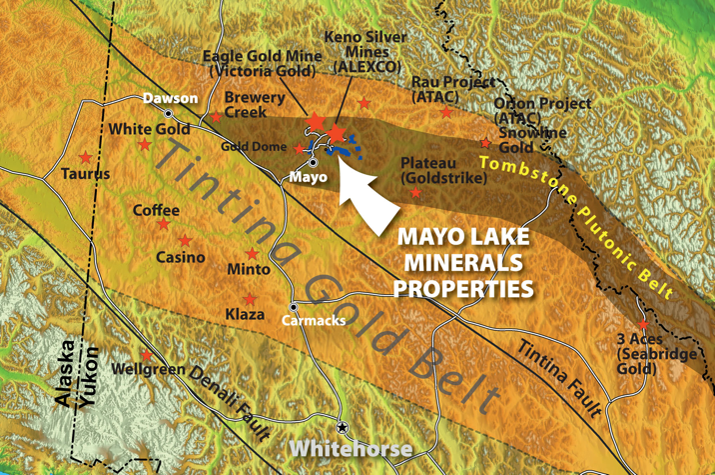
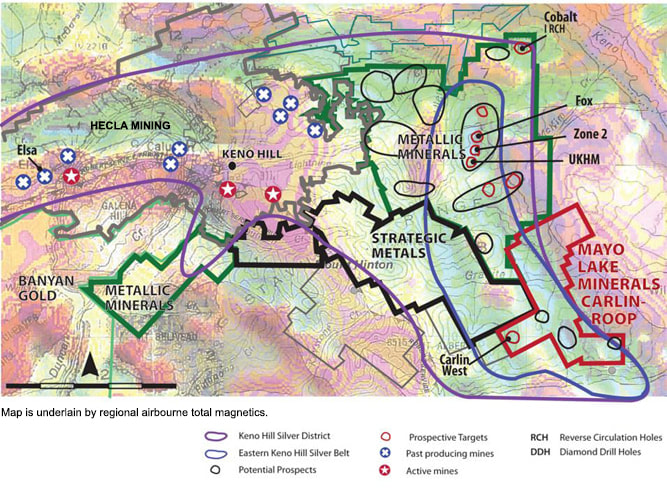
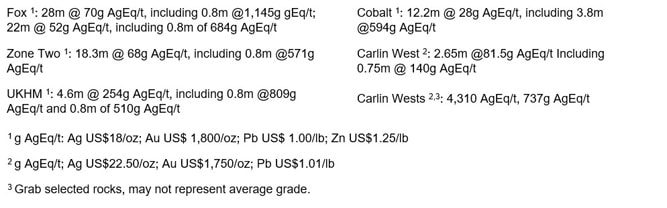
Beginning in 2019, the high prospectivity of the Carlin-Roop property for silver was realized from the presence of a very anomalous, 600m plus long soil anomaly related to structural elements common to the Keno Hill Silver District. Shallow IP and a limited 2 hole diamond drill program of 205m identified Keno Hill Silver Mineralization in two zones, confirming its potential for ore-grade silver deposits (Figure 2).
Soil sampling, geophysics and the presence of an intrusive at Trail-Minto indicates the potential for a deposit similar to that at Victoria Gold’s Eagle Mine. A broad 2 km by 3 km magnetic low with associated gold and base metal anomalies points to a significant subsurface multi-element subsurface deposit(s) at Edmonton. Gold in soil anomalies at Cascade are present in a tectonized and over thickened rock sequence.
All of MLM’s claim groups are located close to road infrastructure, with the three largest of them directly accessible by road. The nearby Wareham Dam has the potential to increase capacity to power more nearby projects.
The Keno Hill Silver Camp
The KHC is defined by most geologists as a belt of high-grade silver-lead-zinc rich vein deposits (Keno Hill Style Mineralization; KHSM) approximately 21 km long and 2 to 6.5 km wide that crosses parts of Galena, Keno and Sourdough Hills north and east of Mayo Lake in the Yukon. The camp contains 16 important deposits, defined as those that produced over 15.55 t (500,000 oz) of Ag, another 19 that shipped smaller amounts to a smelter, and 35 minor occurrences.
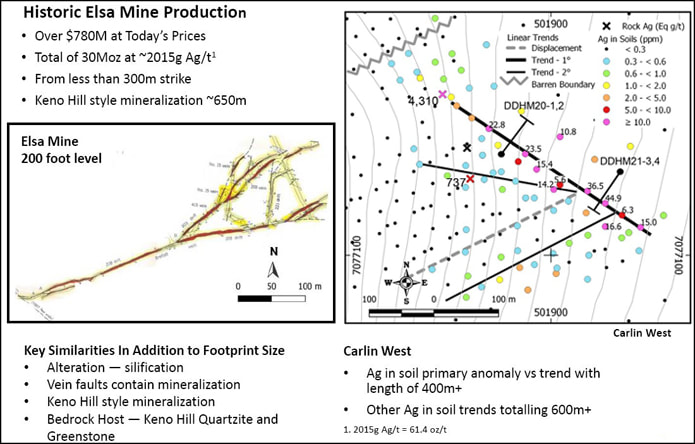
The KHSC produced a total of 214M Oz of silver between 1913 and 1990 with the Elsa Mine being the second largest producer at 30M Oz., which at today’s prices is approximately US$780M.’ ¹
Recently, three companies with the largest holdings focused on silver, Metallic Minerals, Alianza Minerals and Mayo Lake Minerals have expanded their exploration programs during the last two years. Metallic Minerals’ exploration was completed in the central and eastern sector of the Keno Hill Silver District (KHSD), Alianza Minerals’ the far west extent of the KHSD and Mayo Lake Minerals’ the southeastern sector ² (Figure 2 and Figure 3). Mayo Lake Minerals and Metallic Minerals’ work in the eastern sector of the KHSD have demonstrated that KHSM (high-grade silver) is present in this underexplored part of the KHSD. Mayo Lake Minerals have noted similarity in the footprint size and geology of the productive Elsa mine and Mayo’s Carlin West discovery (Figure KH1).
¹ Excerpts from Great Mining Camps of Canada 1.The History and Geology of the Keno Hill Silver Camp, Yukon Territory; R. J. (Bob) Cathro (2006).
² The KHSD is a slightly expanded version of the KHSC.